Layer 01
Accounting standards.
IPSAS, in English, French, Spanish, Portuguese, Russian, and Arabic, so a user anywhere works in their own language. Every citation resolves to a real paragraph in a real standard.
A Pavitt Public Finance product
A checklist says the box was ticked. The Desk files the citation that proves it.
Submit a transaction (with its supporting PDFs) or ask the question in plain language. The Desk checks it against donor procedures, accounting standards, national statute, and your own internal rules, and returns each finding with the exact citation that backs it: the paragraph in IPSAS, the section of the donor manual, the clause in the PFM Act. On file, retrievable at any later audit. If the answer isn't in the source, the Desk tells you so. Its findings (especially where the source gives no answer) quickly build your risk-weighted pool for review.
The problem
Donors (governments and international organisations alike) increasingly want proof that the money they hand out is administered properly. The job of proving it falls to the compliance officer: an internal auditor, sometimes a retained fiscal agent. And every transaction has to satisfy a long list of rules:
The status quo is a checklist per rulebook, worked down by hand, sampled later. The Desk checks the transaction against every layer you switch on, in minutes, with the citation for each finding attached and filed.
Switch on what applies
Three switchable layers cover the five rulebooks: the accounting standard, the donor rules, and your own framework: statute plus internal procedures. The fifth rulebook, good practice, isn't a switch: it is woven into every answer, and flagged as guidance rather than citation, because good practice has no paragraph number.
Each layer can be switched on for an inquiry.
IPSAS, in English, French, Spanish, Portuguese, Russian, and Arabic, so a user anywhere works in their own language. Every citation resolves to a real paragraph in a real standard.
A government recipient or a small NGO can demonstrate compliance for up to nine donors: World Bank · European Union · Asian Development Bank · United Nations · UK (FCDO) · Gavi · The Global Fund · HACT (UN cash transfers) · Australia (DFAT). Layers are purchasable individually: pay for the donors you actually report to.
On Customised plans, national statutes and your internal procedures (the PFM Act, procurement thresholds, grant manuals, financial instructions) are added to the reference base and checked like any other layer.
The standard tells you how to account for it; the donor rules tell you whether it qualifies; your statutes tell you whether it is lawful. The Desk answers all three, and every answer can be verified at the source.
Sample answer
“We received a 4 million euro grant from a bilateral donor with conditions tied to construction milestones. How do we recognise this under IPSAS 23?”
The construction milestones are conditions under IPSAS 23, not stipulations. The grant gives rise to a liability on receipt; revenue is recognised as each milestone is satisfied and the obligation is reduced. Do not recognise the full 4 million as revenue on receipt of cash.
Measure the liability at the consideration received. As milestones are met (verifiable through your project documentation), reduce the liability and recognise revenue. If a milestone cannot be met and the donor would require return of funds, the liability remains until the matter is resolved.
For your reporting period: only the portion of milestones actually met by year end goes to the surplus or deficit. The remaining unmet portion stays on the statement of financial position as a liability (transfers received in advance).
Document the milestone schedule, the verification evidence for each milestone met, and the recalculated liability balance at reporting date. Cross-reference to the donor agreement and to your project completion certificates.
If your milestone schedule or accounting policy differs from typical practice, the Desk will ask. If the question falls outside IPSAS into local statute, the Desk says so unless you're on a Customised plan.
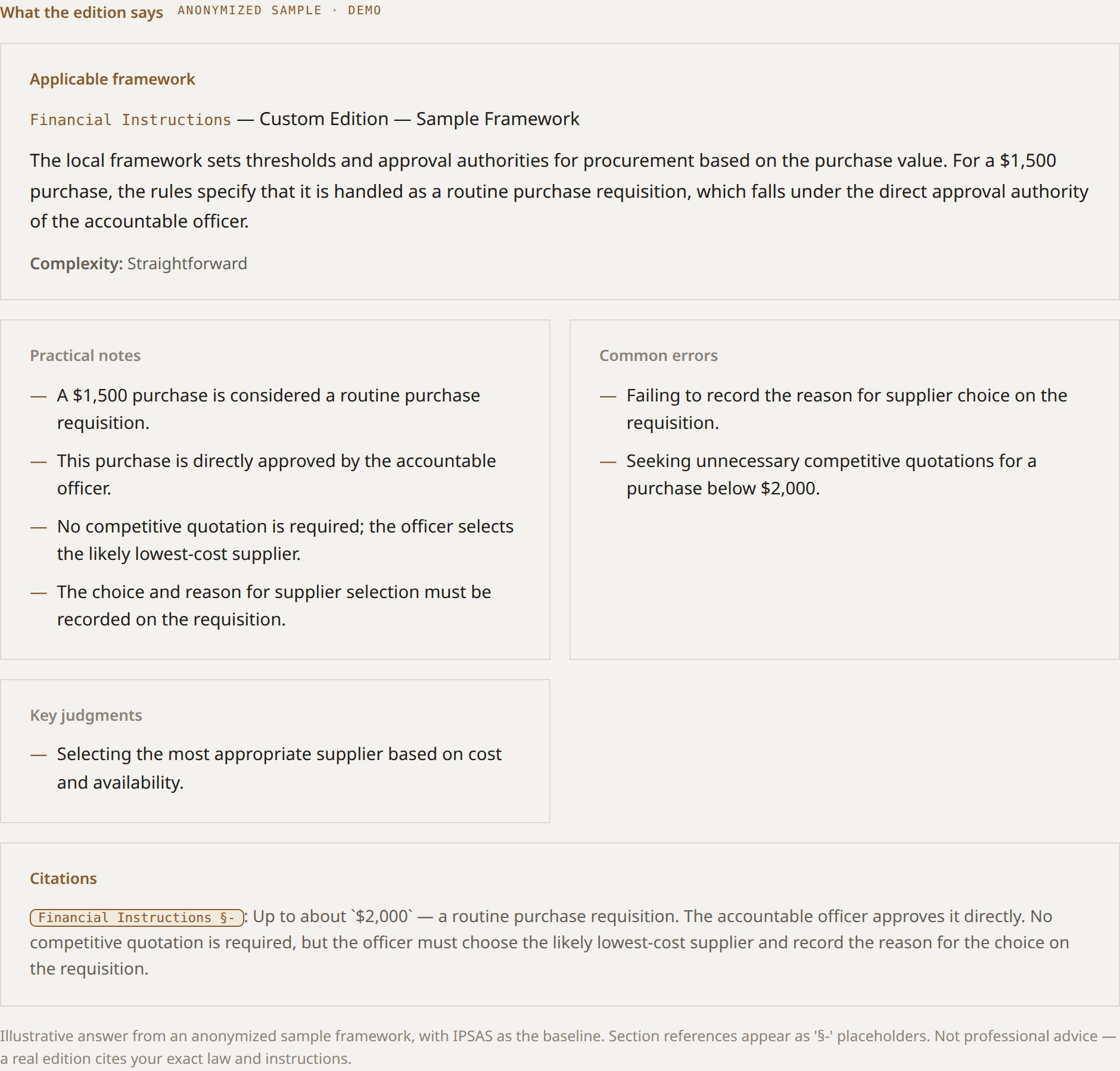
The standard compliance question doesn't need a new opinion. It needs the right paragraph in the right source (the standard, the donor manual, the Act), written in language that holds up when the auditor asks why.
The Desk gives you exactly that. Ask in plain language; upload the supporting documentation. You get back the applicable rule, the specific paragraph or section, a recommended treatment for your context, and (where it matters) a note on the working-paper documentation an auditor will expect. Every citation is verifiable. None are invented.
The missing function
The Big Four have a technical desk: specialists their staff can route hard questions to and get a sourced answer back in time for the audit close. Ministries of Finance, line ministry accounts teams, and the smaller audit firms that serve them do not have that. A senior PFM advisor at several hundred to a couple of thousand per day is the wrong tool for everyday questions, too expensive, too slow, rarely available when the close is due Friday.
The Desk is that missing function: available continuously, on the questions that come up week to week: accounting treatments, donor eligibility, procurement compliance. It will even provide the sample journal entries you need.
Conflict of interest
The other answer ministries reach for is the cheapest one: ask the auditor. They know the standards, they're already engaged, and they're polite about giving informal guidance. But the auditor giving advice on the entry then auditing the entry is a conflict of interest, awkward for both sides and harder to defend each year the practice becomes further embedded in the books.
The Desk gives the controller a defensible position before the audit visit, with the citation already attached, your own working-paper position, sourced and ready. For the small audit firm serving as the technical desk for clients they then audit, the Desk removes that conflict too.
The deepest layer
The accounting layer is where generic tools fail first, so it's where the Desk goes deepest.
Most AI accounting tools were built for the IFRS / FASB market and added IPSAS later, if at all. The result: shallow handling of the standards that matter most in public sector (IPSAS 23 non-exchange revenue, 24 budget reporting, 32 service concession arrangements, 35 consolidated statements) and the GFS reconciliation that ties government accounts back to fiscal reporting.
The Desk is built around those standards, by a practitioner who applies them on real engagements. The IFRS-equivalent treatments are there too, where they help, but the centre of gravity is public sector.
Jurisdiction, entity type, reporting basis, which IPSAS standards you've adopted, and which compliance layers apply: which donors, which internal frameworks. Answers are tuned to your situation, not generic.
"We received a 4-million-euro grant from a bilateral donor with conditions tied to construction milestones. How do we recognise this under IPSAS 23, and does the spend to date qualify under the donor's procedures?" The Desk identifies the applicable rules, reads the documents you upload, and answers each layer in context.
Paragraph citations, recommended treatment, suggested working-paper note. Copy what you need into your file. The citation is verifiable; it points to a real paragraph in a real standard.
For proving that every transaction above your threshold satisfies the donor's procedures, the standard, the statute, and your own rules, with the citation filed for the audit that comes later. Headquarters can review field-office work remotely; site visits get shorter and rarer.
For when the question is too hard for the team but too small to bring in a consultant: controller-level treatments that need a defensible answer fast. Get a sourced answer, defend it to your auditor, move on.
For firms that audit governments but don't have a public-sector technical desk. The Desk fills that role: ask, cite, document, sign.
For consultants who need to give a defensible answer quickly to a Ministry counterpart, with the citation already attached.
Honest about boundaries
The Desk is a research, reference, and verification tool, not a replacement for professional judgment or audit. It will give you a sourced position on a compliance question; you and your team are still responsible for the decision and the audit response.
It also doesn't pretend to know what it doesn't know. If a question requires entity-specific information the Desk doesn't have, it asks. If a question falls outside IPSAS into local statute or regulation, it says so (unless you're on a Customised plan, where local statute and regulation can be added to the Desk's reference base).
Languages
The Desk answers in all six languages. English, French, and Spanish answers are grounded in the official IPSAS translation for the language you are working in, not machine-translated from the English source.
For French- and Spanish-speaking users specifically, the Desk distinguishes between two adoption paths: countries that have adopted the official French or Spanish translation of IPSAS, and countries that use the international (English-source) IPSAS rendered in their working language. Citation paragraph numbers and effective dates differ between the two; the Desk surfaces the version appropriate to your country.
The Portuguese, Russian, and Arabic interfaces are fully available; Portuguese-, Russian-, and Arabic-language answers are produced from the English IPSAS source, since there is no separate official Portuguese, Russian, or Arabic IPSAS translation in the reference base. Relevant for francophone and lusophone Sub-Saharan Africa, Spanish-speaking Latin America, the Arabic-speaking public sector across the Middle East and North Africa, and any team producing statutory reports in more than one of these languages.
Built by a practitioner
The Desk is curated and operated by Gregg Pavitt, currently embedded in the Solomon Islands Ministry of Finance & Treasury. Earlier work across Sub-Saharan Africa, South Asia, and the Pacific, and before that a long stretch of US municipal finance directorship work, direct and outsourced. The reference base is the actual IPSAS standards plus IPSASB framework documents and selected public-sector application guidance. Updates are pushed as the standards are revised. CPA; full CV and references on LinkedIn.
 World Bank
 European Union
 USAID
USAID Millennium Challenge Corporation
 DFAT (Australian Aid)
 FCDO
FCDOHow is this different from ChatGPT or general AI tools?
How is this different from IFRS Buddy / Acclara / IFRS Companion?
Which donors does the Desk cover?
Can it check our own procurement manual and financial instructions?
Can it handle our local jurisdiction?
Will the answer hold up in an audit?
Is the data and documents I upload kept private?
What if I'm just learning IPSAS?
Start with a 14-day free trial: generous query allowance, no credit card needed to look around. The trial includes every donor layer; after the trial you keep the layers you subscribe to. Add a card to keep going past day 14.
For audit firms, ministries, and donor-funded organisations, see team and organisation pricing. Customised plans (your local statute and regulation added to the reference base) are available for organisations that need them.
Goes together
Desk verifies the transaction, layer by layer. Drills builds the team's reflexes in the deepest layer, the accounting. Bench shows where the team's capability gaps are. The Series, Rules, Unfiltered, covers the patterns at system level.